Enhanced Government Financial Oversight: Reducing Fraud with AI and Metadata Analytics
Improving The Effectiveness of Government Auditing
Irakli Petriashvili
4/20/20261 min read
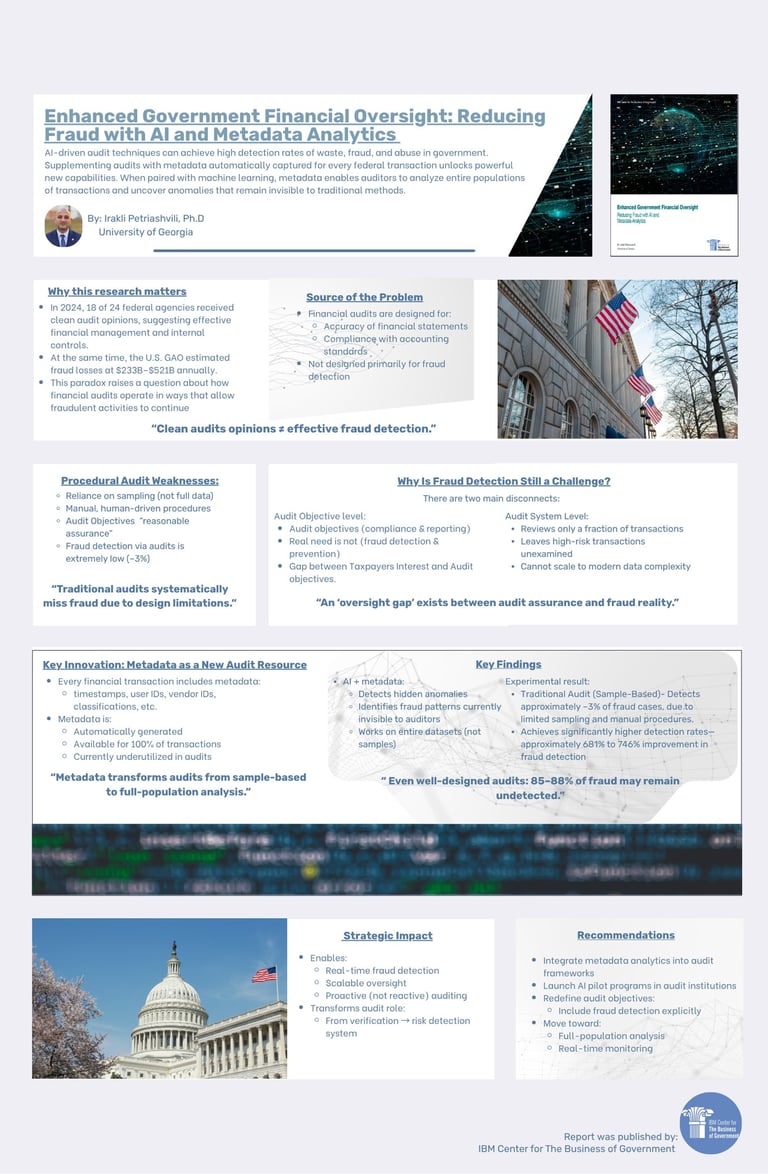
Federal financial audits need strategic transformation to advance beyond the constraints of the current framework. Despite having two strong oversight layers with the Offices of Inspector General and the Government Accountability Office, financial audit design fails to detect massive fraud in government spending.
The evidence reveals a stark contradiction. In 2024, 18 of 24 federal agencies received clean audit opinions, suggesting effective financial management. Yet the Government Accountability Office estimates the federal government loses $233 billion to $521 billion annually to fraud. The disconnect exposes fundamental flaws in how financial audits operate and reveals systematic blind spots that allow fraudulent activities to continue undetected.
Findings demonstrate that current federal financial audits focus on whether agency financial statements comply with federal accounting standards, rather than detecting fraud, waste, and abuse. The misalignment creates dangerous oversight gaps. Additionally, the current audit framework, specifically audit sampling methods, examine only small fractions of government transactions, leaving potentially high-risk payments out of the scope even when their total value exceeds audit materiality thresholds.
Experimental analysis using real Department of Defense transaction data demonstrates the severity of these limitations. Testing revealed that existing audit sampling methods detect fraud at alarmingly low rates, between 11.8% and 14.7%. These results mean 85-88% of fraudulent transactions escape detection through conventional audit procedures.
The analysis demonstrates that metadata - accompanying every government transaction-provides powerful yet underutilized fraud detection capabilities. The machine learning approach demonstrated that using metadata analyses is 681% to 746% more effective detecting fraudulent activity than samplings.
By combining machine learning with metadata analytics, Inspector General Offices can analyze entire populations of transactions without relying solely on supporting documents such as invoices or contracts, enabling them to detect anomalies and fraud patterns that standard procedures are missing.
Published by the IBM Center for The Business of Government, Washington, DC, 26 March 2026.
Also available at: IBM Center: https://www.ibm.com/businessofgovernment/reports/enhanced-government-financial-oversight