When Government Decisions Become Unexplainable
Irakli Petriashvili
6/8/20263 min read
There is a quiet moment in every audit when you ask a simple question: Why was this decision made? For most of the history of public administration, someone could answer. A rule was followed, a discretion was exercised, a file recorded the reasoning. The trail might be incomplete or self-serving, but it existed. You could follow it back to a human being who could be asked, challenged, and held to account.
That moment is changing. As governments across Europe adopt artificial intelligence, a growing share of public decisions are produced by systems that work well and explain nothing. They are accurate, fast, and increasingly trusted and when you ask them why, they cannot tell you. The challenge this poses is not the one we have been trained to expect. We have learned to worry about bias, and rightly so. But beneath bias lies something more fundamental: the erosion of auditability itself.
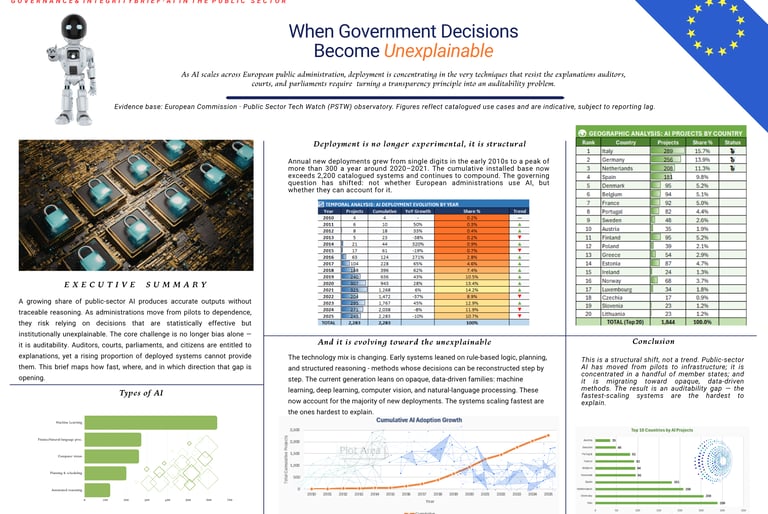
The numbers describe a transition that is already structural rather than experimental. The European Commission's Public Sector Tech Watch observatory has catalogued more than two thousand AI deployments across public administrations, and annual additions have grown more than tenfold over the past decade. What began as scattered pilots has become infrastructure, woven into how tax authorities assess, how agencies allocate, how services reach citizens. The relevant question is no longer whether European governments use AI. It is whether they can still account for what it does.
The harder problem is the direction of travel. Early public-sector systems leaned on rule-based logic, planning, and structured reasoning, methods whose decisions can be reconstructed step by step, the way a careful auditor reconstructs a transaction. The current generation leans elsewhere: toward machine learning, deep learning, computer vision, and natural-language processing. These are the techniques scaling fastest, and they are also the ones most resistant to explanation. We are not drifting toward greater transparency as the technology matures. We are concentrating capability in precisely the methods that make accountability hardest.
I find this troubling for reasons that are professional and personal at once. The institutions I work with audit offices, courts, parliaments, the slow and unglamorous machinery of public oversight, exist on a single premise: that power must be able to explain itself. A citizen who is denied a benefit, flagged for investigation, or refused a permit is owed a reason. Not because reasons are a courtesy, but because they are the mechanism through which a decision can be questioned, appealed, and corrected. Remove the explanation and you do not merely inconvenience the auditor. You sever the thread that connects a decision to the people it affects and to the institutions meant to answer for it.
This is what an auditability gap really means. It is not a technical inconvenience to be patched later. It is the widening distance between what a system decides and what anyone can justify on its behalf. Left unaddressed, it produces a public sector that is effective and unaccountable in the same breath a combination that has never ended well for democratic trust.
The encouraging part is that this is a gap we can choose to close. Explainability and documentation can be written into procurement rather than retrofitted after deployment, so that the obligation to explain travels with the system from the moment it is bought. Audit methodologies can be developed to test model-driven decisions, not just the paperwork around them. And public institutions can agree on a shared transparency baseline for the decisions that touch citizens' rights most directly. None of this requires halting innovation. It requires insisting that innovation in the public sphere carries the same duty every act of public power has always carried: the duty to be answerable.
I write about these questions because I believe accountability is not the enemy of progress but its condition. A government that cannot explain its decisions has not become more modern. It has become less legible to the people it serves. The task ahead is to ensure that as our tools grow more capable, our institutions do not grow more opaque,and that the simple, essential question at the heart of every audit still has an answer.
Why was this decision made? We should never reach the point where no one can say